After World War II Australia set up a large-scale program of migration to bring out some of the millions of displaced people of Europe. During this time in Australia there was a desperate shortage of labour and a growing belief that substantial population growth was essential for the country's future. Since then, some seven million people born overseas have made their home here.
![adelaide4[1]](https://blogger.googleusercontent.com/img/b/R29vZ2xl/AVvXsEjufizCRY_J4MQCfbl_wCBXRwg4MiQMJ3FeITEH_XnEGwf5qJ_iDkppy8kz_yvojgJoPuW-FaGQ6nW8zMRDi180QMBnD5pE8VKSjflun5gqIEsYfF5DpSlbK3c-sia05kiiUEqNK-cJUMI/?imgmax=800 "adelaide4[1]")
My own Irish ancestors arrived in South Australia over 160 years ago during the Irish potato famine, and I can still recall the sense of ‘foreignness’ that we felt towards the largely Italian communities that settled around us on the eastern side of the Adelaide Plains. We rather admired the way they took over bricklaying, concreting and masonry jobs in the building industry, while laughing at the handkerchiefs tied around their heads, their poor but lilting English, and the strange foods their children had stuffed between enormous slices of crusty bread in their school sandwiches. We drank tea, not coffee! We’d never eaten pizza! We certainly would never eat pickled eggplants and capsicums!
 Looking back now, I find myself with a real affection for these small nuggetty people who showed us how to grow fruit and vegetables in our own backyards, who made their own wine, pickled olives, made sausages, hand-rolled pasta, baked wood-fired bread and pizza, and who kept rabbits for eating and chickens for eggs. Most notable of all was their powerful sense of community and their rich connection between garden and table and family life.
  Their children have blended into the population, speak with Aussie accents, but can still be spotted among the polyglot suburban Australians by their dark hair and Italian names. Best of all, they have contributed to the Adelaide ‘coffee culture’; hardly anyone drinks tea socially anymore, and we think of pizza and bruschetta as ‘regular’ food.
One of the last remnants of these older post-war generation of Italian immigrants in our street is an old Italian lady who lives over the road; this is her recipe for pickling and preserving eggplants (aubergines), as passed along to my wife.
Peel the eggplants and slice them thickly.

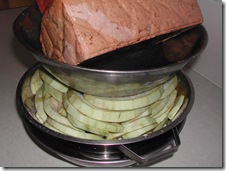
Place them in layers in a stainless steel colander, which itself sits in a stainless steel dish of similar size to collect the fluid pressed out of the eggplants. Coat each layer generously with sea-salt.

Put another stainless-steel dish on top of this assemblage, and put a few heavy house-bricks into this dish to add pressure. Leave stand overnight.

Next, boil the eggplant slices in a pungent mix of 1 cup of water and 3 cups of white vinegar for a few minutes, then lay them out between clean sheets (folded over) to allow the slices to shed excess water.


Now mix thoroughly with olive oil, chillies, garlic and dried oregano. Lay the sliced eggplant flat in layers with the spices in between. 
If this mix is not refrigerated, but stored instead in jars in the cellar, it needs to be covered with olive oil.






![adelaide4[1]](https://blogger.googleusercontent.com/img/b/R29vZ2xl/AVvXsEj4kzqNCCvzE7zsHmRk8Kah-fOqcoF8HoJ4FOl9D1fudIX5V6A_LcGFsvJGRucN77BVfZscAyVe8YkEo842mb7t3c395FGpyLrq6n3M-WZVtb9rw8CcFuOs8W3pyKADHzPhc4cSizDkruI/s1600-h/adelaide4%5B1%5D%5B6%5D.jpg "adelaide4[1]")


