One of the greatest pleasures afforded the kitchen gardener is the ever-changing activities of the birds that visit us directly or that fly overhead. Unlike our shy nocturnal Australian native animals, Australian birds are about in daylight and are highly visible, colourful, playful, noisy and busy.

Fifty years of studying these birds has given me the gift of immediate identification – by flight, song, size or silhouette. Yet there is always more to learn, and endless fascination. Birds play, fight, kill, swoop, soar and glide. They hunt through the garden on a daily basis and keep all sorts of insect predators in check – all for the price of the meal. They pollinate fruit trees and charm with their songs (harsh-voiced parrots aside!) Nature has moved onto the drought-proof Adelaide Plains to fill every ecological niche open to birds – my records show visits by some forty-five (45) species.
Sadly, birds are difficult to photograph compared to fruit and vegetables, and so I’ve included photos by others (from Wikimedia Commons) to whet your appetite for this simple activity to augment the pleasures of kitchen gardening.
Some of these birds are regulars, some were lost, some flew or wheeled overhead, some passed in great flocks or singly, some are migratory, some are introduced species. Nevertheless, they all give joy in small ways, so here they are, in no particular order…
Parrots
Australia is blessed with a profusion of colourful if raucous parrots, from the large majestic cockatoos to the fast-flying strident-voiced lorikeets. These past few years have seen a return of the bigger parrots to the Adelaide Plains – there are few more majestic sights than the slow flight of some forty or more yellow-tailed black-cockatoos making there way from one pine tree to another.

My parrot list includes rainbow and musk lorikeets, Eastern and Adelaide rosellas, galahs, sulphur-crested and yellow-tailed black cockatoos plus long-billed corellas.
Honeyeaters
Honeyeaters have a brush-like tongue (I’m told) for collecting nectar and pollen from flowers, but are just as likely to be omnivorous; yellow-winged (New Holland) honeyeaters are often seen flying up into the air from fences and bushes at dusk to snatch insects from swarms that fly at that time of day. The largest of the honeyeaters is the red wattle-bird, with its harsh ‘quark-a-quark’ call and small red turkey-like wattles on either side of the bill. The ‘little wattle bird’ is less common but just as attractively striped.

My honeyeater list includes the white-plumed and yellow-winged honeyeaters and red and little wattlebirds. Other small colourful birds of about the same size seen in my garden include the rufous whistler, grey-backed silvereyes and the eastern spinebill. In the skies high above the garden, welcome and white-rumped swallows drift on long pointed wings in their aerial hunt for winged insects. My favourite bird memory is of a migratory Horsfield’s Bronze Cuckoo that stopped in the almond tree for ten minutes to imprint an indelible memory on my mind.
Birds-of-prey
Kookaburras prey on small lizards and mice and can often enough be heard chortling to each other as they mark out the edges of their territories with song. The occasional ‘little falcon’ or Australian Hobby is easily the fastest bird in the skies – I’ve seen them catapult out of no-where to attack Indian Turtle-Doves that flee in panic into the interior of the fruit trees to escape. Black-shouldered kites, Nankeen kestrels and a (lost) wedge-tailed eagle have also been spotted overhead, though never mixing it in the garden. Boobook owls are silent nocturnal predators of rats, mice and other small animals and insects; they can be heard calling mournfully in the wee-small hours, or seen flying silently as darkness closes in as the gardener works on harvesting the last of the potatoes.

Water birds
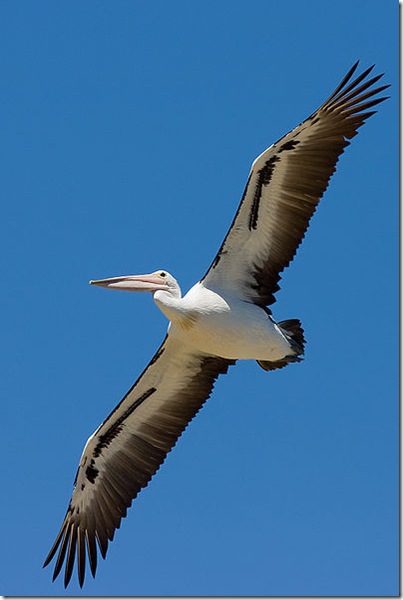
Surprising avian visitors to the skies over the garden are the water-birds, often en-route to somewhere else or just blown inland and lost – these include a stately flight of eight pelicans wheeling overhead, white-faced herons, black ducks, silver gulls and wood (or mountain) ducks. Spur-winged plovers and the occasional Australian white ibis find happy feeding grounds on school ovals in the district.
Common Australian garden birds
Then there’s a motley crew of birds common to Australian gardens – Magpie-larks, white-backed magpies, Australian ravens (mistakenly called ‘crows’), noisy miners, Willy-wagtails and their beautiful cousin the grey fantail, black-faced cuckoo-shrikes and the occasional grey thrush down from the Hills. I once saw a tiny zebra finch flitting through the garden; as these are a flock bird of the Australian deserts, I reckoned this one was probably an escapee from an aviary somewhere nearby.

Introduced bird species
The first Europeans to settle in Australia were less-than-charmed by the colourful parrots with their harsh cries and the seven hundred or so other birds native to Australia, and waxed nostalgic for the songbirds of home – so they imported the bloody things! Now Australian gardens have English house sparrows, blackbirds and starlings, domestic pigeons, Indian turtle-doves and even goldfinches. Each of these species displaces a native species somehow – fortunately for us, the Australian crested pigeon is shoving back, and can be identified by the whirring sound its wings make on take-off and its pointy crest.