Showing posts with label bulbs. Show all posts

Transplanting garlic

The second year after planting a new garlic crop from purchased garlic bulbs is easier than the first; one can transplant garlic that has escaped harvest.

P1040847

Heck, lots of garlic bulbs escaped harvest this past summer; chicken-shed building took over the agenda and I never did get around to digging at least two rows of Shantung and Monaro Purple garlic.

P1040834Luckily for me, Mother Nature was back-stopping my gardening failures and these full bulbs have sprung back to life and popped up with perfect timing. I gave the rows a good soaking then lifted these clumps of garlic with the shovel. As soon as they come out and the surplus soil has been gently brushed off they go into a tub of rainwater laced with Seasol, a seaweed solution that lacks nitrogen and phosphorous but helps the bulbs survive the transplant shock (or so I’m told by my friendly garlic expert mate).

P1040858

P1040863Transplanted garlic is planted in the same way as onion seedlings; the individual plants are gently pulled apart to separate their root systems. They are then laid one-and-a-half bulb diameters apart up against the wall of pre-hoed trenches. The loose trench walls are pushed back over the roots and bulbs to cover them then patted down. It doesn’t matter that the garlic plants are now lying somewhat sideways; they will straighten up as they chase the light.

P1040869I like garlic – its  easy to grow and is easily our most valuable crop by weight; the price of garlic rises at certain times of the year to as much as $40 per kilogram. Its quick to plant, stores well and makes the cook happy when there’s a good stock of it up at the kitchen. Several hundred bulbs have been planted out in a single morning. These will be ready for harvesting mid-summer (around Christmas time in southern Australia).

Best of all, one need not keep buying or holding back harvested garlic bulbs; just leave some of the crop in the soil for transplanting the following year. Quick and cheap!

Garlic Sunday

It’s the last weekend in autumn down-under in southern Australia and therefore ‘Garlic Sunday’ on the Adelaide Plains.

P1020881

P1020862Faced with the annual pilgrimage to Germany, as of next weekend, it’s also my last chance to get the early garlic planted out and the winter mulch onto the garden paths. Pretty much everything else is in order after eight months of effort since our return from Germany at the start of the Australian Spring in September last year. Summer crops have come and gone, autumn and winter crops are planted, all thirteen garden beds are full, but my stock of seed garlic is dawdling along and refusing to be ready…

P1020897So there’s nothing for it but to go along with Mother Nature at her own pace; I can clearly only plant out those garlic varieties that have sprouted in readiness for the new season. The two varieties that are half ready – ‘Monaro Purple’ and ‘Shantung’ – get picked over and the garlic cloves broken out ready for dropping (sprout up) in the trenches.

P1020899

The other varieties  - ‘Printanor’, ‘Ail de Pays Gers’ and ‘Italian White’ – are still locked down hard inside their skins, and so will be placed in the shed on my work bench in the sun for the five weeks of my absence to shift them along a bit. By then the cold weather will have set in, and I’ll be able to occupy myself planting out the last 8 kg of seed garlic during the sunny middle hours of our winter days. 

Birds, bed-bases and bulbs

Springtime for the kitchen gardener is the most hectic time of the year, and particularly so here in southern Australia where Spring and the approach of Christmas coincide to muddle social pressures into the life of the harried gardener. ‘Spring-cleaning’ makes sense in the cook’s particularly European tradition, where sunshine and warmer weather bring on a frenzy of activity in the house, and things that have lain dormant inside get kicked outside into a warmer clime to make way for the new.

DSCN0001

My one relief from all this activity is to rise early before the cook is astir, and to sit outside overlooking the garden each morning to watch the dawn chorus. Dawn is the busiest time of the day for all those small birds foraging through the kitchen garden in front of me, and the changing patterns of the clouds in the sky over the garden never fail to bring me some peace.
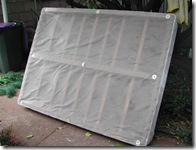
DSCN0021 Except for that bloody bed-base down there on the left, leaning up against the chook-yard fence!

It sticks in my eye with all the irritation of a burr under  a horse’s saddle, and I’ve finally been forced to dispose of it.

DSCN0025So I’ve turned it into a growing frame for my wife’s favourite cucumbers, located as near to the kitchen door as I can get it!  True, it looks a bit junk-yardish at the moment, but in a few months time it will be covered in a a wall of cucumbers, and our summer salads will be blessed by the cook’s smile…

DSCN0027Other useful things salvaged from this bed-base include the felt underlay – perfect for starting carrot seeds – and swatches of cotton waste from the corners; I leave these lying around for the birds to find as they hunt for nest-building material.DSCN0030 DSCN0031Only the synthetic covering goes out in the rubbish.


While vegetable gardens lack the floral elegance of more formal cottage gardens, vegetables flower also – especially in a seed-saver’s garden - and many of these small flowers are irresistible to birds and bees, such as those of the broccoli and lettuces to be seen in bloom below.

DSCN0017

And all those wonderful garlic plants in the foreground? It was only six months ago that they were bulbs, planted out into the cooling soil of mid-autumn, and now finishing up to add flavour to the cook’s welcome meals for months to come…

DSCN0010

DSCN0014


DSCN0003

DSCN0008

DSCN0009


DSCN0013

DSCN0015


Clockwise from top-left: Flowers of Italian parsley, purple-sprouting broccoli, bitter lettuce and chives.